
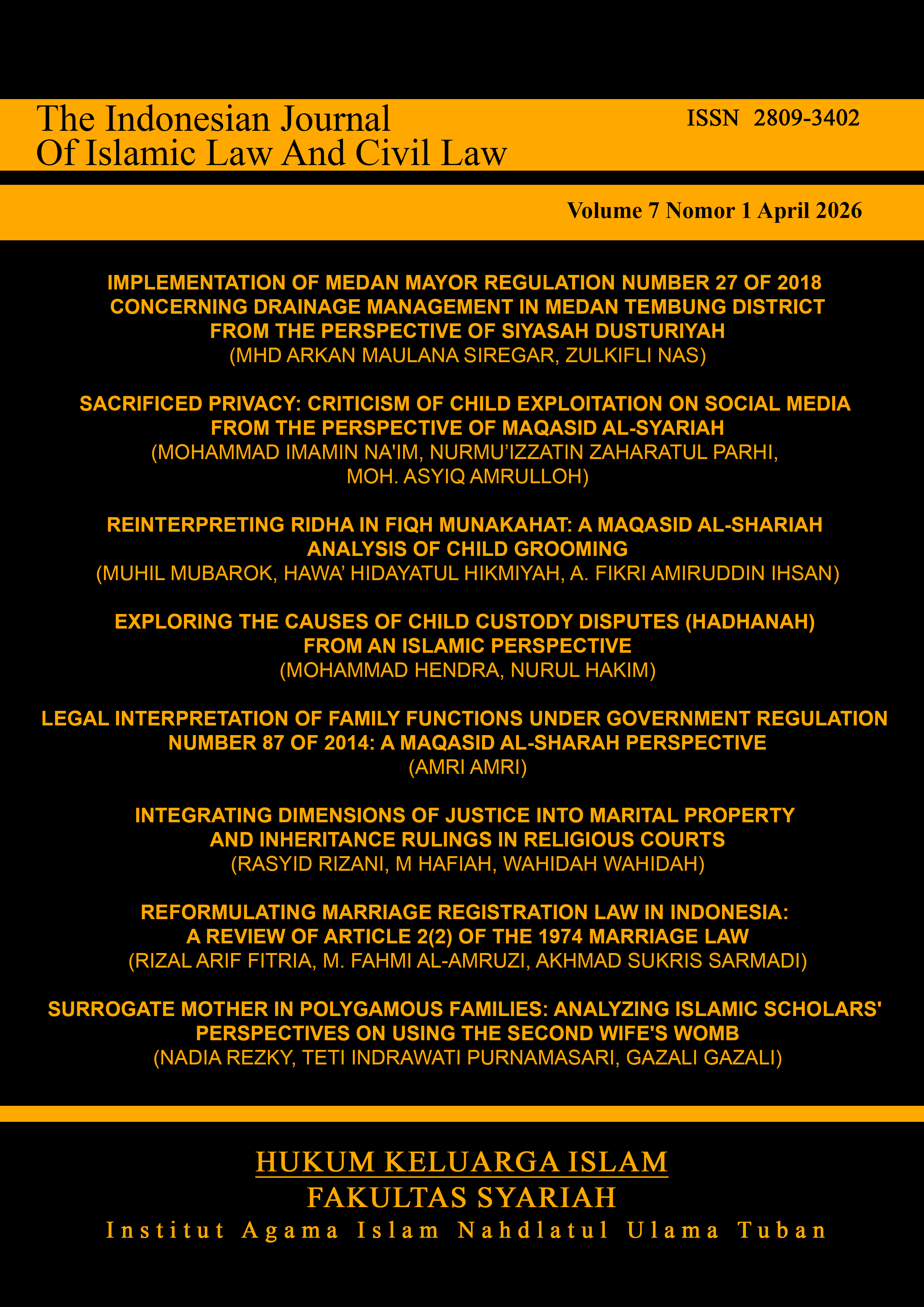
Legal Interpretation of Family Functions under Government Regulation Number 87 of 2014: A Maqasid al-Sharah Perspective
DOI:
https://doi.org/10.51675/83g8cx70Keywords:
Legal Interpretation, Family Functions, Government Regulation, Maqāṣid al-Syarī‘ahAbstract
Government Regulation Number 87 of 2014 establishes key family functions as the foundation for developing resilient and high-quality families in Indonesia. However, existing studies tend to describe these functions normatively, with limited analysis of their alignment with Islamic legal objectives, particularly within the framework of Maqasid al-Shariah. This study addresses that gap by examining the extent to which the regulation reflects the core principles of Maqasid al-Sharah, namely the protection of religion, life, intellect, lineage, and property. This research employs a normative legal method using statutory and conceptual approaches, with Maqasid al-Shariah as the primary analytical framework. The findings indicate that the family functions outlined in Government Regulation Number 87 of 2014 religious, affectionate, protective, reproductive, educational, and economic are substantively aligned with the objectives of Maqasid al-Shariah . The study contributes by offering a more critical and integrative interpretation, demonstrating that the regulation not only serves administrative purposes but also embodies fundamental values of protection and welfare. Thus, it confirms the normative coherence between state law and Islamic legal principles in promoting prosperous, harmonious, and sustainable families
References
A, Amri, and Athoillah Islamy. “Homosexuality in Contemporary Islamic Legal Approaches : Study of Huzaemah Tahido Yanggo ’ s Thought.” Al-’ADL 15, no. 2 (2022): 89–108. https://doi.org/10.31332/aladl.v15i2.4063.
Abū Ḥāmid al-Ghazālī. Iḥyā’ ‘Ulūm al-Dīn. Dār al-Fikr, 1991.
Agung Kurniawan, Hamsah Hudaf. “Konsep Maqashid Syariah Imam Asy-Syatibi Dalam Kitab Al-Muwafaqat.” Al Mabsut 15, no. 1 (2021): 29–38. https://doi.org/10.56997/almabsut.v15i1.502.
Ahmad, Risdawati, Nila Irchamniah, Okta Pujiana, Joan Hesti, and Gita Purwasih. “SOCIAL CONSTRUCTION IN FAMILY BEGGARS IN SUKUN DISTRICT MALANG.” Jurnal Sosiologi Pendidikan Humanis 3, no. 1 (2018): 47–54. https://dx.doi.org/10.17977/um021v3i1p47-54.
Amri. Anak Yang Ditinggalkan : Sebuah Dimensi Psikologis, Sosial Dan Hukum. PT. Literasi Nusantara Abadi Grup, 2026.
Amri, Amri. “Disfungsi Nilai Maqhasid Syariah Terhadap Perceraian Karena Alasan Ekonomi Di Masa Pandemi Covid-19.” Jurnal Tassamuh 14, no. 2 (2022): 308–28.
Anisa, Lina Nur. “The Impact of Zhihar on Women ’ s Rights in the Perspective of Gender Jurisprudence.” The Indonesian Journal of Islamic Law and Civil Law 5, no. 2 (2024): 174–92. https://doi.org/10.51675/jaksya.v5i2.906.
Arikunto, Suharsimi. Prosedur Penelitian: Suatu Pendekatan Praktik. Rineka Cipta, 2022.
Arsyad AT, M. “Kajian Kritis Tentang Akulturasi Islam Dan Budaya Lokal.” Zawiyah : Jurnal Pemikiran Islam 5, no. 1 (2019): 1–20. https://dx.doi.org/10.31332/zjpi.v5i1.1358.
Asmaret, Desi. “DAMPAK CHILD FREETERHADAPKETAHANAN KELUARGADI INDONESIA.” ADHKI: JOURNAL OF ISLAMIC FAMILY LAW 5, no. 1 (2023): 73–89. https://doi.org/DOI:%2520www.doi.org/10.37876/adhki.v5i1.108.
Auda, Jasser. Maqasid Al-Shariah as Philosophy of Islamic Law: A Systems Approach. International Institute Of Islamic Thought (IIIT), 2008.
Dhian, Theresia. “Ecopreneurship Berbasis Digital Marketing Untuk Meningkatkan Pendapatan Ibu PKK Desa Gunung Pasir Jaya.” Jurnal Pemberdayaan Ekonomi 2, no. 2 (2023): 55–63. https://doi.org/10.35912/jpe.v2i2.1522.
Duval, Evelyn Millis, and Brent C Miller. Marriage and Family Development (Sixth Edition). Harper & Row, 1985.
Dwi, Winda, Astuti Zebua, &. Syifa, and Astasia Utari. “Virtual Ethnography Study on the Use of Social Media for Education on Prevention of Stunting in Children.” Proceeding International Conference on Social Sciences, no. November (2019): 229–39.
Faisal, Amri, Risman, and Aisyah. “Islamic Compromise in the Marriage of the Papuan Muslim Marind Tribe.” International Journal of Islamic Thought 26, no. 25 (2024): 55–65. https://doi.org/10.24035/ijit.26.2024.301.
Faizah, Isniyatin, Ah. Soni Irawan, and Silvana Kamelya. “Peran Kantor Urusan Agama Dalam Penguatan Keutuhan Rumah Tangga: (Studi Program SEKOPER HATI Di KUA Kecamatan Tuban).” Minhaj: Jurnal Ilmu Syariah 7, no. 1 (2026): 124–38. https://doi.org/10.52431/minhaj.v7i1.4214.
Faizah, Isniyatin, Alantama Prafastara Winindra, and Dewi Niswatin Khoiroh. “IMPLEMENTASI KAIDAH DAR’UL MAFASID MUQADDAMUN ‘ALA JALBIL MASHALIH TERHADAP PENCATATAN PERKAWINAN DI INDONESIA.” As-Sakinah Journal of Islamic Family Law 2, no. 1 (2024): 1–11. https://doi.org/10.55210/jhki.v1i2.333.
Firdaus, Firdaus, and Nurus Shalihin. “Extended Case Method (ECM) in Social and Cultural Research.” ETNOSIA : Jurnal Etnografi Indonesia 6, no. 1 (2021): 9–23. https://doi.org/10.31947/etnosia.v6i1.7147.
Ghani, Sulhan Hamid A. “Paradigma Jasser Auda Tentang Maqashid Al Syari’ah.” Jurnal Paradigma 7, no. 1 (2019): 1–28. https://doi.org/10.53961/jurnalparadigma.v7i1.17.
Gheauş, Anca. “Love, Not the Family.” Societatea de Analize Feministe 25, no. 1 (2018): 168–76.
Haidi Nurfadilah, Idzni, Fenti Dewi Pertiwi, and Tika Noor Prastia. “Gambaran Pernikahan Dini Pada Pus (Pasangan Usia Subur) Di Kelurahan Pasir Jaya Kecamatan Bogor Barat Tahun 2019.” Promotor 4, no. 4 (2021): 322. https://doi.org/10.32832/pro.v4i4.5599.
Hermanto, Agus, and Ihda Shofiyatun Nisa’. “Ekologi Rumah Tangga Harmonis: Konsep Mubadalah Sebagai Kunci Utama.” The Indonesian Journal of Islamic Law and Civil Law 5, no. 1 (2024): 92–108. https://doi.org/10.51675/jaksya.v5i1.734.
Ivana, Theresia, Ermeisi Er Unja, Uniek Mulyaning Sari, and Jalan Zafri Zam-zam. “PENERAPAN FUNGSI KELUARGA DAN PERAN LINTAS SEKTOR PADA KAMPUNG KELUARGA BERENCANA DI KALIMANTAN SELATAN.” Jurnal Keluarga Berencana 7, no. 2 (2022): 54–63.
Januario, Ridwan Angga, Fadil Sj, and Moh. Thoriquddin. “Hakikat Dan Tujuan Pernikahan Di Era Pra-Islam Dan Awal Islam.” Jurnal Al-Ijtimaiyyah 8, no. 1 (2022): 1. https://doi.org/10.22373/al-ijtimaiyyah.v8i1.11007.
Mahfudz, Lauhul, Eka Marita, and Putri Fauzi. “Analisis Program Pusat Layanan Keluarga Sakinah Dalam Menjaga Ketahanan Keluarga Studi Kasus KUA Kecamatan Dlanggu.” The Indonesian Journal of Islamic Law and Civil Law 6, no. 1 (2025): 121–36. https://doi.org/10.51675/jaksya.v6i1.1066.
Marzuki, Peter Mahmud. Penelitian Hukum. Kencana Prenada Media Group, 2014.
Maulana, Hafidh, and Sri Wahyu Handayani. “Implementasi Program Pemberdayaan Kesejahteraan Keluarga Dalam Penerapan 8 Fungsi Keluarga Gampong Meunasah Krueng.” Jurnal Ilmiah Ilmu Sosial 10, no. 1 (2024): 96–105. https://doi.org/10.23887/jiis.v10i1.78810.
Mohd Al Adib Samuri, and Noor Aziah Mohd Awal. “Drivers of Child Marriage among Rohingya Refugees in Malaysia.” Samarah: Jurnal Hukum Keluarga Dan Hukum Islam 9, no. 2 (2025): 803–24. https://doi.org/10.22373/ntsxet30.
Mukramin, Sam’un, and Muhammad Nawir. “Kehidupan Prostitusi Dan Agama.” Equilibrium: Jurnal Pendidikan Vol 6, no. No.1 (2019): 28.
Musyafa, M., Fauziyah Malik, and Muhammad Hanif Rumaday. “Peran Ayah Dan Dampaknya Pada Kemandirian Psikologi Anak Di Lingkungan Urban-Multikultural Kota Jayapura.” The Indonesian Journal ofI Slamic Law and Civil Law 6, no. 2 (2025): 273–90. https://doi.org/10.51675/jaksya.v6i2.1326.
Nur, Afrizal, and Mukhlis Lubis. “Konsep Wasathiyah Dalam Al-Quran (Studi Komparatif Antara Tafsir al-Tahrîr Wa at-Tanwîr Dan Aisar at-Tafâsîr).” An-Nur 4, no. 2 (2015): 205–25.
Nurmila, Nina. “Pemahaman Agama Dan Pembentukan Budaya Patriarki.” KARSA: JURNAL SOSIAL DAN BUDAYA KEISLAMAN 23, no. 1 (2015): 1–16. https://doi.org/10.19105/karsa.v23i1.606.
Peraturan Pemerintah Republik Indonesia Nomor. 87 Tahun 2014 Tentang Perkembangan Kependudukan Dan Pembangunan Keluarga, Keluarga Berencana, Dan Sistem Informasi Keluarga.
Putri, Ranti Satriani, Neviyarni, and Zelhendri Zen. “Pengaruh Lingkungan Sosial Terhadap Perkembangan Psikologis Anak Sekolah Dasar.” Cognoscere: Jurnal Komunikasi Dan Media Pendidikan 3, no. 2 (2025): 1–6. https://doi.org/10.61292/cognoscere.273.
Rahmayati, T. Elfira. “Konflik Peran Ganda Pada Wanita Karier.” Juripol (Jurnal Institusi Politeknik Ganesha Medan) 3, no. 1 (2020): 152–65. https://doi.org/10.33395/juripol.v3i1.10920.
Ras, Atma, Nuvida Raf, Dimas Ario Sumilih, Hariashari Rahim, and Andi Nurlela. “Analisis Peran Orang Tua Dalam Optimalisasi Fungsi-Fungsi Keluarga Di Desa Latekko Kabupaten Bone.” Jurnal Neo Societal 6, no. 2 (2024): 161–77.
Rizki, Darlin, Frina Oktalita, and Ali Sodiqin. “Maqasid Sharia Perspective in Changes the Marriage Age Limits for Women According to Law Number 16 of 2019.” Al Istinbath 7, no. 2 (2022): 487–508. https://doi.org/http:dx.doi.org/10.29240/jhi.v7i2.4016.
Rohita, Rohita, and Rizqi Maulida. “THE IMPLEMENTATION OF THE FAMILY ’S RELIGIOUS FUNCTIONS.” VISI : Jurnal Ilmiah Pendidik Dan Tenaga Kependidikan Pendidikan Non Formal 13, no. 2 (2018): 75–82. https://doi.org/10.21009/JIV.1302.1.
S, Nurbaini E., and HS Salim. Penerapan Teori Hukum Pada Penelitian Tesis Dan Disertasi. Raja Grafindo Persada, 2013.
Salvicion, and Celis. Bina Keluarga (Terjemahan). Rineka Cipta, 1998.
Sariroh, ST., Moh Ali, Amri, and Abd. Syakur. “DOKTRIN KEAGAMAAN NAHDLATUL ULAMA SEBAGAI ROLE MODEL TOLERANSI UMAT.” Poros Onim: Jurnal Sosial Keagamaan 3, no. 2 (2022): 102–13. https://doi.org/10.53491/porosonim.v3i2.358.
Soeroso, Moerti Hadiati. Kekerasan Dalam Rumah Tangga Dalam Pespektif Yuridis Vitimologi,. Sinar Grafika, 2010.
Song, Yuequn, Can Cui, Yajiang Jia, et al. “Family Functioning and Optimism as Protective Factors of Life Satisfaction Among Stroke Patients During the COVID-19 Epidemic in Shenyang, China.” Frontiers in Public Health 10, no. April (2022): 1–8. https://doi.org/10.3389/fpubh.2022.738634.
Sugiarto, Tiara Syahani, Imanuddin Abil Fida, and Reza Hilmy Luayyin. “Upaya Perempuan Single Parent Dalam Mewujudkan Fungsi Keluarga Bagi Anak ( Studi Kasus Di Kelurahan Jati , Kecamatan Mayangan, Kota Probolinggo).” USRAH: Jurnal Hukum Keluarga Islam 3, no. 87 (2023): 142–62.
Sugiharto, Adam, and Yulina Eva Riany. “Family Characteristics , Family Functions and Socio-Economic Status among Families of Contributory Assistance Recipient in Indonesia.” Journal of Family Sciences 09, no. 01 (2024): 72–86. https://doi.org/10.29244/jfs.v9i1.43941.
Suharso, and Ana Retnoningsih. Kamus Besar Bahasa Indonesia. Lux. Widya Karya, 2018.
Suhayib. “ANALISIS HADIS TENTANG HADANAH DAN RELEVANSINYA DENGAN HIFZHUN NASL.” AT-TABSHIRAH: Jurnal Studi Islam 1, no. 1 (2024): 14–26. https://doi.org/jurnal.islamicfamily.net.
Thariq, Muhammad. “Interpersonal Communication Role for Self-Concept of Children and Families.” Budapest International Research and Critics Institute (BIRCI-Journal) : Humanities and Social Sciences 1, no. 2 (2018): 181–94. https://doi.org/10.33258/birci.v1i2.21.
Zakaria, Soni. “The Contextualization Of The Māqāṣid Āl-Šyāriāh Jasser Auda Theory In The Concept And Practice Of Islamic Family Law.” Al-’Adl 14, no. 2 (2021): 83. https://doi.org/10.31332/aladl.v14i2.2396.
Zein, Muhamad, and Muhktar Alshadiq. Mebangun Keluarga Harmonis. Graha Cipta, 2005.
Zulfikri, Zulfikri, and Isniyatin Faizah. “Sadd al-Dzari’ah sebagai Media dalam Penyelesaian Perkara Kontemporer.” The Indonesian Journal of Islamic Law and Civil Law 4, no. 2 (2023): 169–85. https://doi.org/10.51675/jaksya.v4i2.474.
Downloads
Published
Issue
Section
License
Copyright (c) 2026 Amri Amri

This work is licensed under a Creative Commons Attribution-ShareAlike 4.0 International License.

4.png)


