
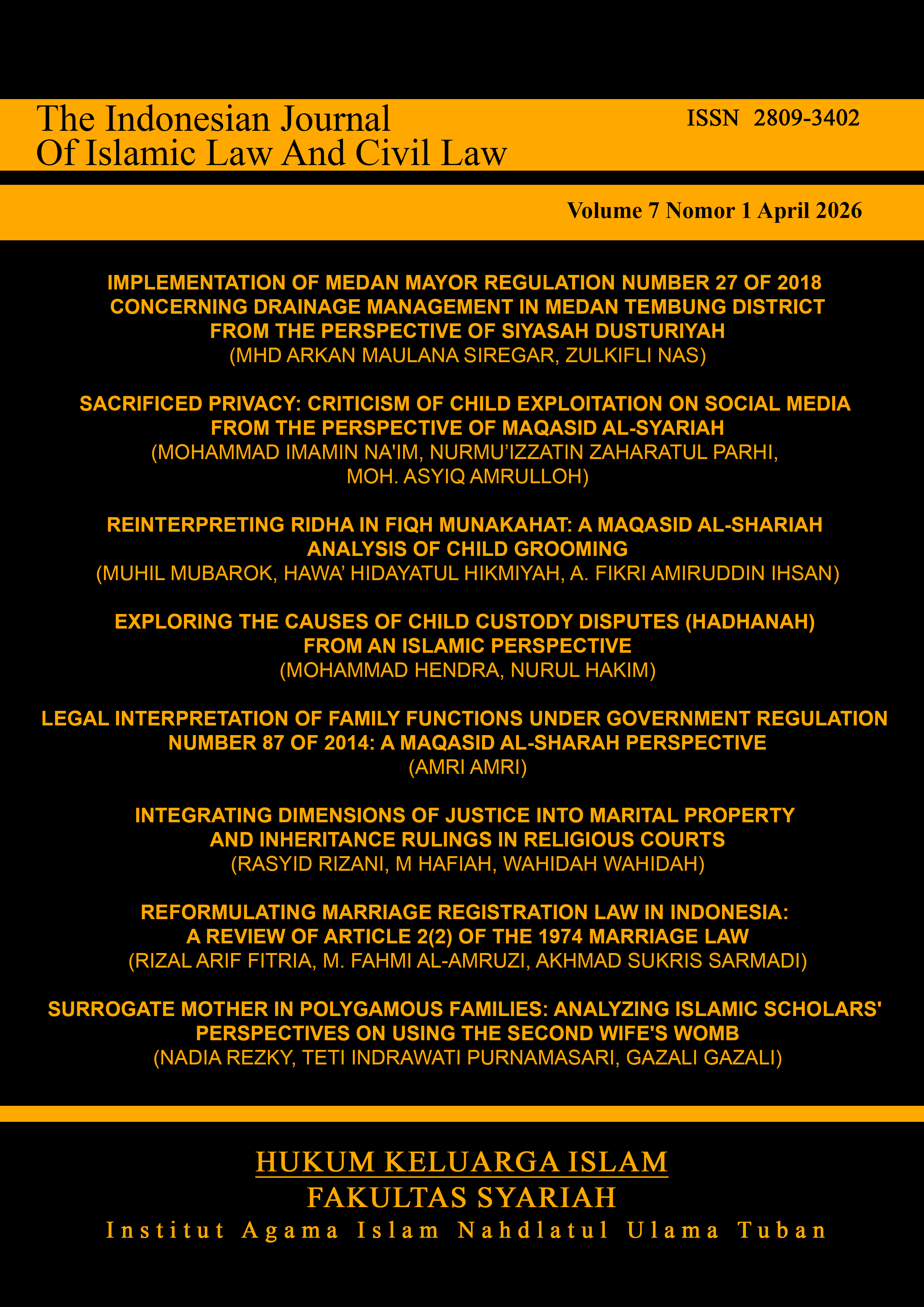
Sacrificed Privacy: Criticism of Child Exploitation on Social Media from the Perspective of Maqasid al-Syariah
DOI:
https://doi.org/10.51675/58b4x444Keywords:
Child Exploitation, Social Media, Privacy, Children’s Rights, Maqāṣid al-Sharī’ahAbstract
The phenomenon of children being used as content on social media solely to pursue viewers has generated serious problems, as it neglects their fundamental rights. Based on this concern, this study aims to explain why children should not be exploited as content merely for social media viewers and to analyse it through the perspective of maqasid al-Syariah. The research employs a qualitative approach using the library study method. Data sources were obtained from books, journal articles, proceedings, research reports, and credible official websites, which were then analysed within the framework of maqasid al-Syariah. With its descriptive, analytical, and explorative character, this study does not only describe the practice of child exploitation on social media but also interprets its impact on the five fundamental principles of maqasid al-Syariah, namely religion, life, intellect, lineage, and property. The findings reveal that turning children into digital content clearly harms their best interests. Such practices violate the right to protection, cause psychological trauma, erode privacy, and shift the meaning of the parent–child emotional bond into that of a producer–actor relationship. The analysis of maqasid al-Syariah confirms that this phenomenon contradicts hifz al-nafs as it endangers life, hifz al-‘aql as it disrupts intellectual development, hifz al-nasl as it weakens the foundation of lineage, and hifz al-mal as financial motives cannot justify sacrificing a child’s dignity. Therefore, the exploitation of children in digital media has neither moral nor religious legitimacy. This research contributes to strengthening the conceptual basis for parents, policymakers, and industry actors to be more sensitive in protecting children in the digital sphere, while also enriching academic literature with a robust and applicable normative-religious framework.
References
Akbar, Rasona Sunara, M Akram Hutasuhut, M Andhika Arya Rifansyah, M Yoga Dwinanda, M Rizky Ash Shiddiq, Pandu G Rahardandi, and Wahyu Purnama Aji. “Bela Negara Di Era Digital: Tantangan Dan Strategi Memperkokoh Nilai-Nilai Kebangsaan Melalui Teknologi.” Innovative: Journal Of Social Science Research 4, no. 4 (2024): 8418–28. doi:10.31004/innovative.v4i4.10783.
al-Imām Abū Isḥāq al-Shāṭibī. Al-Muwāfaqāt Fī Uṣūl al-Sharī‘ah. II. Beirut: Dar al-kutub al-Islamiyyah, 2003.
Antonio Silva Esquinas, Jorge Ramiro Pérez Suárez, Raquel Rebeca Cordero Verdugo, and Julio Díaz Galán. Researching Social Media with Children: #DigitalEthnography #Storytelling. 1st ed. London: Routledge, 2024. 10.4324/9781003399315.
Benavides, Teresa Berenice Treviño, and Flor Esthela Morton Rodríguez. “Children on Social Media: An Exploratory Study of Their Habits, Online Content Consumption and Brand Experiences.” Journal of Digital & Social Media Marketing, 2019.
Benjamin Burroughs and Gavin Feller. “The Emergence and Ethics of Child-Created Content as Media Industries.” In The Routledge Companion to Digital Media and Children, 1st ed. Routledge: Routledge, 2020. 10.4324/9781351004107-20.
Blum-Ross, Alicia, and Sonia Livingstone. “‘Sharenting,’ Parent Blogging, and the Boundaries of the Digital Self.” In Self-(Re) Presentation Now, 70–85. London: Routledge, 2020.
Freitas, Bárbara Morais Santiago, Natália Fernandes, Paula Gaudenzi, and Bárbara Costa Andrada. “Between Play and Exploitation: What Is the Place of the Rights of Child YouTubers?” European Journal of Investigation in Health, Psychology and Education 14, no. 5 (May 1, 2024): 1197–1213. doi:10.3390/ejihpe14050079.
Grace Yiseul Choi and Jennifer Lewallen. “‘Say Instagram, Kids!’: Examining Sharenting and Children’s Digital Representations on Instagram.” Howard Journal of Communications 29, no. 2 (April 3, 2018): 144–64. doi:10.1080/10646175.2017.1327380.
Hiniker, Alexis, Sarita Y Schoenebeck, and Julie A Kientz. “Not at the Dinner Table: Parents’ and Children’s Perspectives on Family Technology Rules,” 1376–89, 2016. doi:10.1145/2818048.2819940.
Huda, H Uu Nurul, MH SH, H Tatang Astaruddin, M Si SH, Muhammad Irsan Nasution, MH SH, SH Alwi Al Haddad, Dian Rachmat Gumelar, and MH SH. Data Pribadi, Hak Warga, Dan Negara Hukum: Menjaga Privasi Di Tengah Ancaman Digital. Bandung: Penerbit Widina, 2024.
Hudders, Liselot, Steffi De Jans, and Emma Beuckels. “Kidfluencers and the Commodification of Childhood: A Comprehensive Review and Research Agenda in Contemporary Entertainment.” In Advertising Literacy for Young Audiences in the Digital Age : A Critical Attitude to Embedded Formats, edited by Beatriz Feijoo and Erika Fernández Gómez, 65–83. Cham: Springer Nature Switzerland, 2024. doi:10.1007/978-3-031-55736-1_5.
Irena Zervas. “Profit Without Privacy: Family Content Creators and Child Influencers.” Northeastern University Political Review, March 19, 2024. https://nupoliticalreview.org/2024/03/19/profit-without-privacy-family-content-creators-and-child-influencers/.
Kadir, Zul Khaidir. “Dari Privasi Ke Eksploitasi: Memetakan Jejak Kriminalisasi Revenge Porn Dalam Era Media Sosial.” Dewantara: Jurnal Pendidikan Sosial Humaniora 4, no. 1 (2025): 133–52. doi:10.30640/dewantara.v4i1.3812.
Leaver, Tama. “Intimate Surveillance: Normalizing Parental Monitoring and Mediation of Infants Online.” Social Media + Society 3, no. 2 (April 1, 2017): 2056305117707192. doi:10.1177/2056305117707192.
Lestari, Citra Apik, Khairani Zikrinawati, and Ikhrom Ikhrom. “Dampak Overstimulasi Konten Digital Terhadap Pemusatan Perhatian Anak.” PAEDAGOGY: Jurnal Ilmu Pendidikan Dan Psikologi 5, no. 1 (2025): 198–205. doi:10.51878/paedagogy.v5i1.4941.
Ouvrein, Gaëlle, and Karen Verswijvel. “Sharenting: Parental Adoration or Public Humiliation? A Focus Group Study on Adolescents’ Experiences with Sharenting against the Background of Their Own Impression Management.” Children and Youth Services Review 99 (April 1, 2019): 319–27. doi:10.1016/j.childyouth.2019.02.011.
Sari, Cucun Cundaya Fitria, and Yuda Pratama. “Perlindungan Hukum Terhadap Eksploitasi Anak Melalui Platform Digital Tiktok.” Risalah Hukum 20, no. 2 (2024): 91–101. doi:10.30872/risalah.v20i2.1592.
Sari, Ratih Frayunita. “Menyoal Kebablasan Berpendapat: Malfungsi Media Sosial Sebagai Panggung Produsage Konten Negatif.” Jurnal Penelitian Pers Dan Komunikasi Pembangunan 23, no. 1 (2019): 1–16. doi:10.46426/jp2kp.v23i1.86.
Schirmer, Miriam, Angelina Voggenreiter, and Jürgen Pfeffer. “More Skin, More Likes! Measuring Child Exposure and User Engagement on Tiktok.” arXiv, 2024. doi:10.48550/arXiv.2408.05622.
Sefthian, Sefthian, and Masduki Asbari. “Peran Media Sosial Dalam Komunikasi Bisnis Di Era Ekonomi Digital.” Jurnal Ilmu Sosial, Manajemen, Akuntansi Dan Bisnis 2, no. 1 (2025): 29–36. doi:10.70508/5mxjp089.
Sitorus, Deskia Renata, Bambang Fitrianto, Andreas Nainggolan, Nathanael Marvelino Saragih Sidauruk, and Reinhard Mark Luhut Silaen. “Kekosongan Regulasi Atas Sharenting Komersial: Urgensi Eksaminasi Sebagai Pengawasan Dalam Perlindungan Anak Di Era Digital.” Jurnal ISO: Jurnal Ilmu Sosial, Politik Dan Humaniora 5, no. 1 (2025): 13–13. doi:10.53697/iso.v5i1.2463.
Steinberg, Stacey B. “Sharenting: Children’s Privacy in the Age of Social Media.” Emory Lj 66, no. 2 (2016): 839. https://scholarlycommons.law.emory.edu/elj/vol66/iss4/2/.
Sugitanata, Arif, and Sarah Aqila. “Transformasi Pengasuhan Anak Di Era Digital: Analisis Fenomena ‘Sosmedika Mom’ Dan Dampaknya Terhadap Ibu-Ibu Modern.” SPECTRUM: Journal of Gender and Children Studies 4, no. 1 (2024): 17–31. doi:10.30984/spectrum.v4i1.1066.
Teresa Treviño and Flor Morton. “Children on Social Media: An Exploratory Study of Their Habits, Online Content Consumption and Brand Experiences.” Journal of Digital & Social Media Marketing 7, no. 1 (2019): 88–97. doi:10.69554/MWBW4195.
Ulfah, Maulidya. DIGITAL PARENTING: Bagaimana Orang Tua Melindungi Anak-Anak Dari Bahaya Digital? Tasikmalaya: Edu Publisher, 2020.
Zaki, Muhammad. “Perlindungan Anak Dalam Perspektif Islam.” Asas 6, no. 2 (2014): 1–15. doi:10.24042/asas.v6i2.1715.
Downloads
Published
Issue
Section
License
Copyright (c) 2026 Mohammad Imamin Na'im, Nurmu’izzatin Zaharatul Parhi, Moh. Asyiq Amrulloh

This work is licensed under a Creative Commons Attribution-ShareAlike 4.0 International License.

4.png)


