
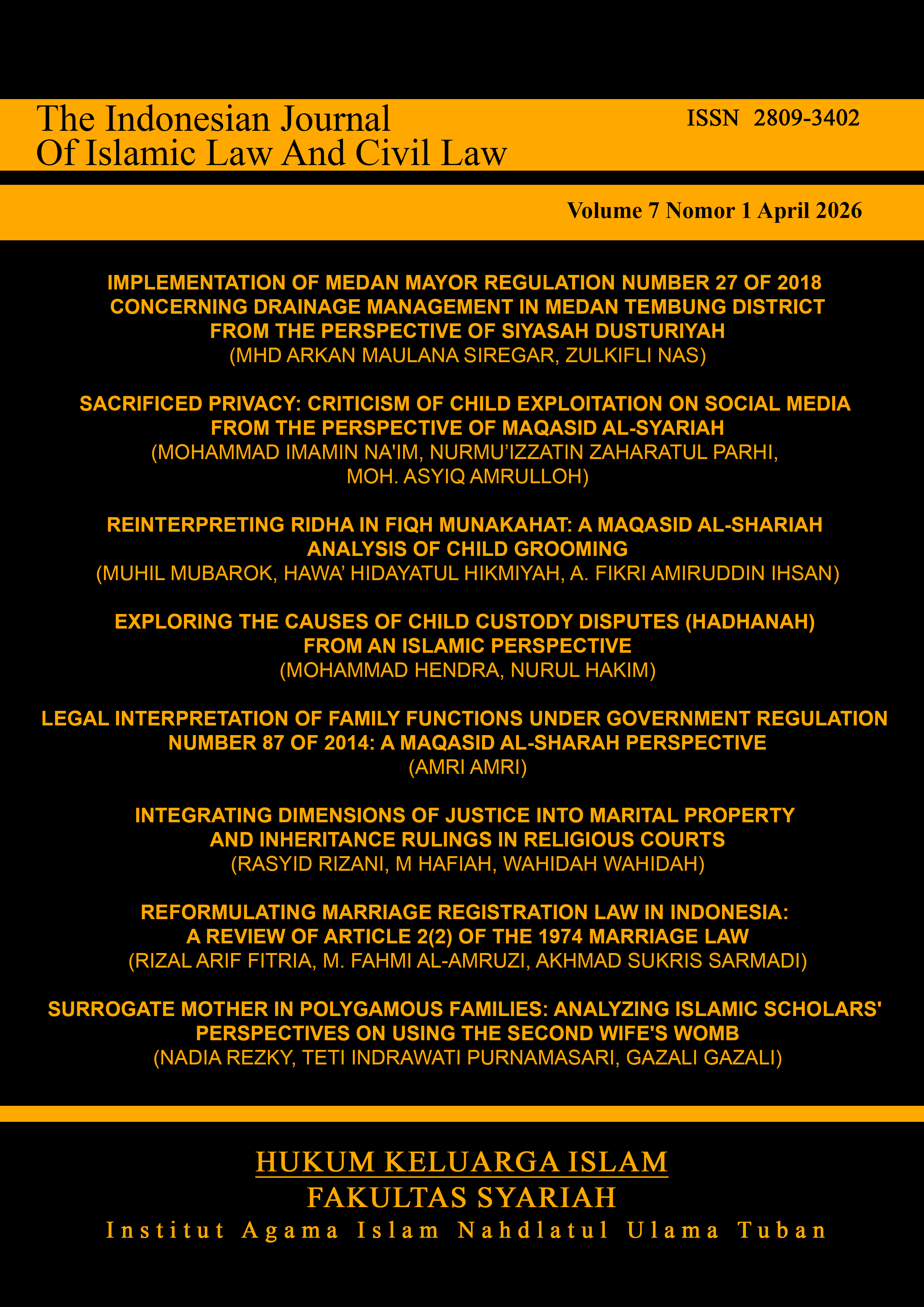
Exploring the Causes of Child Custody Disputes (Hadhanah) from an Islamic Perspective
DOI:
https://doi.org/10.51675/hyv4qd66Keywords:
Child Custody Rights, Islamic Law, Disputes, JusticeAbstract
Child custody (hadhanah) constitutes a fundamental aspect of Islamic law, designed to safeguard the welfare, education, and protection of children following divorce. The principle of justice in Islam emphasizes that the rights of the child must take precedence over parental interests, with due consideration given to compassion, capability, and the suitability of the custodian. This study aims to analyze the concept of child custody from an Islamic perspective, identify the underlying causes of custody disputes, and examine their legal implications within the framework of Indonesia’s religious courts. The research employs a normative approach by reviewing primary sources of Islamic law (fiqh madhhab).
The findings indicate that custody disputes arise not only from divergent interpretations of legal provisions but also from practical challenges. These include: (1) the absence of parental affection, which often triggers disputes; (2) financial capacity in relation to child support; (3) the influence of the living environment on parental conflict; and (4) parental customs or traditions that shape approaches to child-rearing.
References
Abdurrahman. Compilation of Islamic Law in Indonesia. Jakarta: CV Akademika Pressindo, 1995.
Badruddin and Aditya Prastian Supriyadi, “The Dynamics of Indonesian Islamic Law: Reactualization of Islamic Norms in Translating Positive Law to Respond to Contemporary Socio-Cultural Era,” De Jure: Journal of Law and Sharia 14, no. 1. 2022.
Choeri Muhammad Efendi, Acmad, “Analysis of Article 105 of the KHI Regarding the Age Limit for Custody of Children Post-Divorce,” Ist’dal 11, no. 1 .2024.
Firdausi, Mir’atul, Tiyan Iswahyuni, and Aufi Imaduddin, “Marriage Age Limits According to Law Number 16 of 2019 on Marriage in Protecting Adolescent Reproductive Health Viewed from Maqashid Sharia,” Islamic Law and Civil Law 5, no. 2 (2024)
Harahap, Solehuddin, “Imam Shafi’i’s Opinion on Family Support When the Husband is Sick,” Journal of Islamic Law El Madani 2, no. 1. 2024
Ilman Putra, Khufazo et al., “Journal of Muhammadiyah Studies and Integration of Knowledge HADHANAH CONSEQUENCES OF DIVORCE PERSPECTIVE OF FIQH AND,” Journal of Muhammadiyah Studies and Integration of Knowledge 1, no. 3. 2023
Joko Sriwidodo, Book of Legal Studies, vol. VIII, 2020.
Kasmawanti & Aprianti, “Customary Law in Indonesia,” Refika Aditama, 2016
Law Number 1 of 1974 concerning marriage
Law of the Republic of Indonesia, Number 23 of 2002 concerning Child Protection.
Maghfirah, “The Concept of Shared Parenting in Hadhanah Post-Divorce: A Study of Contemporary Islamic Marriage Legislation,” Islamic Law, No. 2. 2020.
Mahfudz, Lauhul, Eka Marita Putri Fauzi, and Rinwanto Rinwanto, “Analysis of the Sakinah Family Service Center Program in Maintaining Family Resilience: A Case Study of the Dlanggu District KUA,” The Indonesian Journal of Islamic Law and Civil Law 6, no. 1 2025
Maswandi, Maswandi, “Custody of Minor Children After Divorce,” JPPUMA: Journal of Government and Political Science, Medan Area University 5, no. 1. 2017
Syahputri, Maulida, “Hadhanah Due to Divorce from the Perspective of 4 Madhhabs and Compilation of Islamic Law,” Judge: Law Journal 06, no. 01. 2025
Syu’aib, Kholil, “Fiqh of Imam Zakariya Al-Anshari,” Al-Fikra: Islamic Scientific Journal 10, no. 2 2017.
Wati, Rahma and Latif Aswen, “Gender Equality in the Perspective of Islamic Law,” ULIL ALBAB: Multidisciplinary Scientific Journal 3, no. 1. 2023
Downloads
Published
Issue
Section
License
Copyright (c) 2026 Mohammad Hendra, Nurul Hakim

This work is licensed under a Creative Commons Attribution-ShareAlike 4.0 International License.

4.png)


